

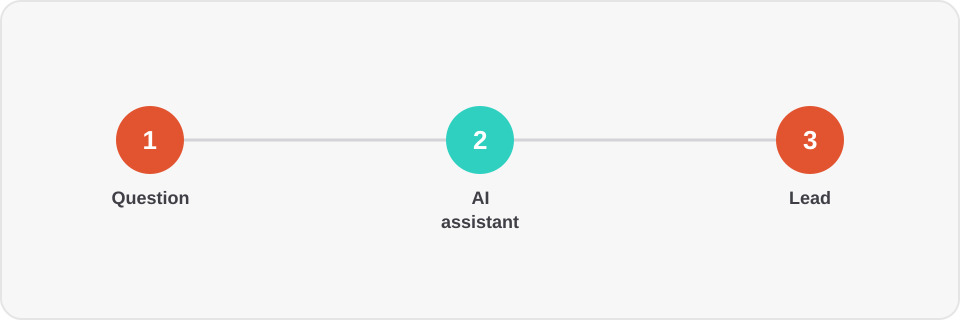
A classic live-chat widget with a "leave a request, we'll call you back" form only solves part of the problem — it collects a contact, but doesn't answer the question the visitor has right now. An LLM-powered AI assistant closes exactly that gap: it answers based on the site's content, qualifies the inquiry, and hands the sales team an already-warm lead with context.
Why this matters for the business, not just "for show"
In practice, an AI assistant solves three concrete problems:
- Takes routine questions off the sales team's plate. Up to 60–70% of chat inquiries are questions the site already answers (delivery terms, timelines, what's included in a plan) — the visitor just doesn't want to search for it. The assistant answers instantly, 24/7, with no human involved.
- Qualifies the lead before handing it to a manager. The assistant can clarify budget, timeline, region — and pass a structured request into the CRM instead of just "hi, interested in working together."
- Lowers the barrier to reaching out. Some visitors don't call or fill out a form simply because it takes effort. A chat conversation is a lower-friction entry point, meaning more inquiries from the same traffic.
How it works technically
An LLM-powered AI assistant for a website isn't "ChatGPT in an iframe." The working setup we typically use includes:
- a knowledge base built from the site's own content — service pages, FAQs, and documentation are indexed and fed to the model as context (RAG), rather than stuffed entirely into the prompt;
- topic constraints — the model is configured to answer only questions relevant to the business, and to gracefully decline irrelevant ones instead of making something up;
- escalation to a human — if the assistant isn't confident in an answer, or the user explicitly asks for a manager, the conversation is handed to a live operator along with the chat history;
- CRM and messenger integration — qualified leads land in your CRM or Telegram automatically, with no manual re-entry.
Common concerns and how they're addressed
"The model will make up wrong answers" — solved through RAG (answers are grounded in the site's actual content rather than the model's general knowledge) and explicit instructions to admit when information is insufficient instead of guessing.
"It's expensive to run" — for most sites with up to a few tens of thousands of visits a month, the token cost per conversation is measured in single dollars, not thousands. The bulk of the cost is in integration, not ongoing operation.
"Customers won't trust a bot" — in practice, trust comes down to transparency: if the assistant honestly identifies itself as an assistant and easily hands off to a human on request, resistance is noticeably lower than when a bot tries to pass itself off as a live operator.
Where to start
Rollout usually doesn't start with the hardest case — it starts with one specific scenario, like answering FAQs and passing qualified leads into the CRM. The scope expands from there as real conversations accumulate. If you'd like to discuss how an AI assistant would fit your site and product — get in touch.