

In the Russian-speaking market, Telegram stopped being just a messenger a long time ago — it's a full-fledged business platform: taking orders, customer support, internal team processes. Meanwhile, building a full mobile app for the same tasks costs several times more and takes much longer to ship. Let's break down when a Telegram bot is the right call, and when it isn't.
What problems a bot solves
In practice, there are three main scenarios:
- Taking and processing orders — the bot replaces a website form or a phone call: the user picks a product/service, provides details, and pays right in the chat via Telegram Payments;
- Support and FAQ — the bot answers routine questions instantly and hands off complex cases to a human operator, reducing support load during peak hours;
- Internal automation — notifying the team about new orders and order statuses, integrating with internal systems without needing to open a separate dashboard.
Bot or Mini App
This isn't an either/or choice — the optimal solution often combines both formats:
- A bot works well for linear scenarios: answering a question, taking an order, sending a notification. It's faster to build and doesn't require a complex UI.
- A Mini App is needed when the scenario requires a full interface — a catalog with filters, a personal account, a multi-step form. Technically, it's a web app (usually on the same stack as the main site) that opens right inside Telegram, with no separate app-store install.
A common mistake is ordering a Mini App straight away where a simple button-based bot would have been enough. That drives up cost and delays launch without any conversion gain.
CRM integration — where leads get lost
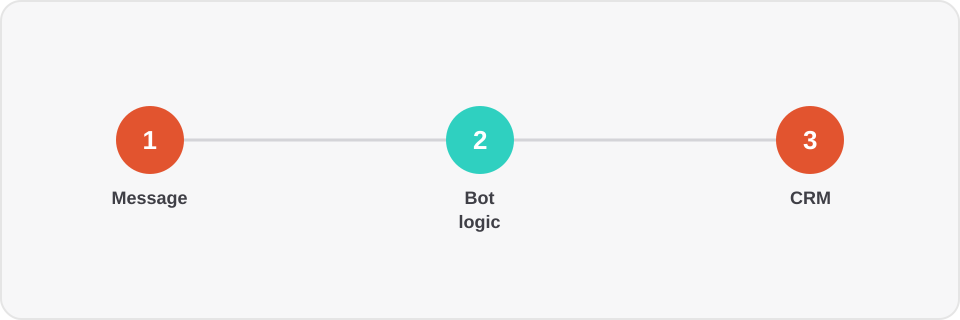
A bot that simply forwards messages into a shared managers' chat works fine at the start, when the volume of requests is small. As volume grows, requests inevitably get lost or duplicated in the chat. The correct architecture is a direct bot-to-CRM integration (amoCRM, Bitrix24, or a custom system) via API: every request is created as a distinct entity with fields, a status, and a conversation history — no manual re-entry.
Technical details that often get overlooked
- Telegram Bot API rate limits — under heavy message volume, you need a request queue rather than direct synchronous processing, or the bot will start replying with delay or crash under load;
- Conversation state storage — multi-step scenarios (a multi-step checkout flow, for example) require storing state between messages, typically in a dedicated database rather than in process memory;
- A fallback channel — if the bot is temporarily unavailable (an update, an outage), there needs to be a clear alternative way for users to reach you, not silence.
Bottom line
A Telegram bot is one of the fastest-payback automation tools for a business serving a Russian-speaking audience — provided the architecture accounts for load growth and CRM integration from the start. If you'd like to discuss a bot or Mini App for your process — tell us about the task.